
Spotting 'Good' (and Bad) PRs
Last updated on 2026-07-14 | Edit this page
Overview
Questions
- What does it mean to be a ‘good’ PR?
- How do you fix a PR that breaks the rules?
Objectives
- Recall the characteristics of a good pull request.
- Practice diagnosing and fixing problematic PRs.
Recap: the Characteristics of a Good PR
You met these when you opened your StarSort PR. Here they are in one place:
| Characteristic | The short version |
|---|---|
| One cohesive change | One PR = one logical thing. (This is the single-responsibility idea: a unit should answer to one purpose.) |
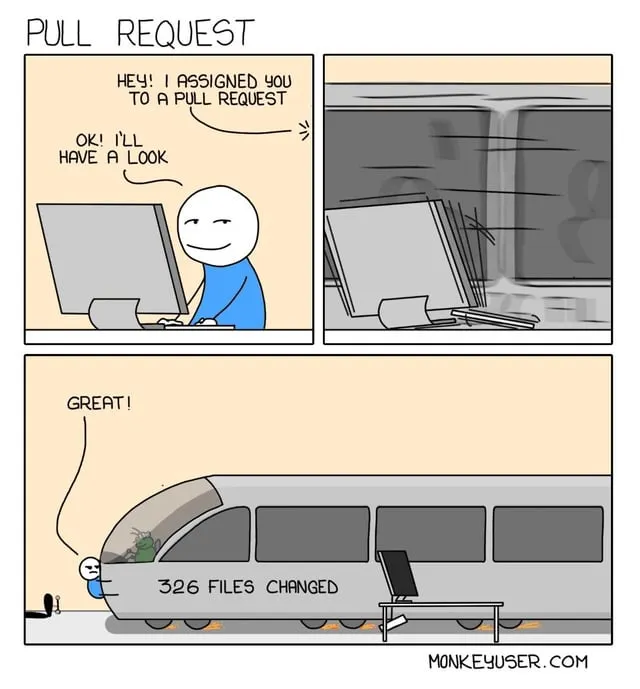
| Reasonable size | Small PRs get reviewed faster and more carefully. Split big ones. |
| What / how / why | The description says what changed, how (incl. side effects), and why. |
None of these are absolute rules — but a PR that follows all three is a gift to whoever reviews it (often future you).
Now You’re the Reviewer
Knowing the habits is one thing; spotting where they’re broken is the real skill. Let’s practice on a few PRs that just landed in StarSort’s queue.
Spot the Problem
For each PR below, name what’s wrong and what you’d ask the author to do.
- PR #41 — “updates” — changes 14 files: fixes the empty-folder crash, renames a function used across the codebase, and adds a brand-new export feature. Description is blank.
- PR #42 — “fix” — a one-line bugfix. Title is just “fix”; no description.
- PR #43 — “Refactor everything before the release” — 2,300 changed lines across 60 files, with the description: “cleaned things up.”
- Does too many things at once (violates one-cohesive-change) and has no description. Ask the author to split it into three PRs — bugfix, rename, feature — each described.
- Not descriptive. The change may be fine, but “fix” tells a reviewer nothing. Ask for a real title and a one-line what/why (e.g., “Fix off-by-one in image index that skipped the last file”).
- Too big and vague. A 2,300-line “cleanup” is nearly unreviewable. Ask the author to break it into focused PRs (one refactor per PR) with descriptions of what and why.
GenAI: A first-pass reviewer (with limits)
LLMs can give a PR a quick first look — flag style issues, summarize a huge diff so a human reviewer knows where to focus, or suggest a clearer description. But they have real limits: they miss project intent and context, can be confidently wrong, and don’t carry accountability. Use AI to prepare a review, not to make a decision — a human still owns the decision to merge. (And for research code, check data/IP policy before pasting a private diff into a third-party tool.)
- A pull request should contain ONE cohesive change.
- A pull request should, ideally, be quickly reviewable.
- A pull request description should give an overview of what, how, and why something changed.
- Diagnosing an oversized, unfocused, or undescribed PR is a core reviewer skill.
- GenAI can assist a review (summaries, first pass) but the human owns the merge decision.